

Image credit: Concept illustration by Suzanne Kantra/Techlicious via ChatGPT
Lab-grown human brain cells may offer a way to build more energy-efficient computers, and a new Braille experiment is an early test of the idea.
At the University of Bristol, researchers fed readings from a robotic touch sensor to tiny clumps of the cells, called organoids. A computer then identified Braille letters from their electrical activity with up to 83% accuracy, according to a study published Friday in Frontiers in Artificial Intelligence.
A robotic arm slid a touch sensor across a 3D-printed board of all 26 Braille letters. Software converted the sensor's input into small electrical pulses, then sent them to each organoid through eight electrodes. The organoids are less than a millimeter across and hold about 10,000 neurons.
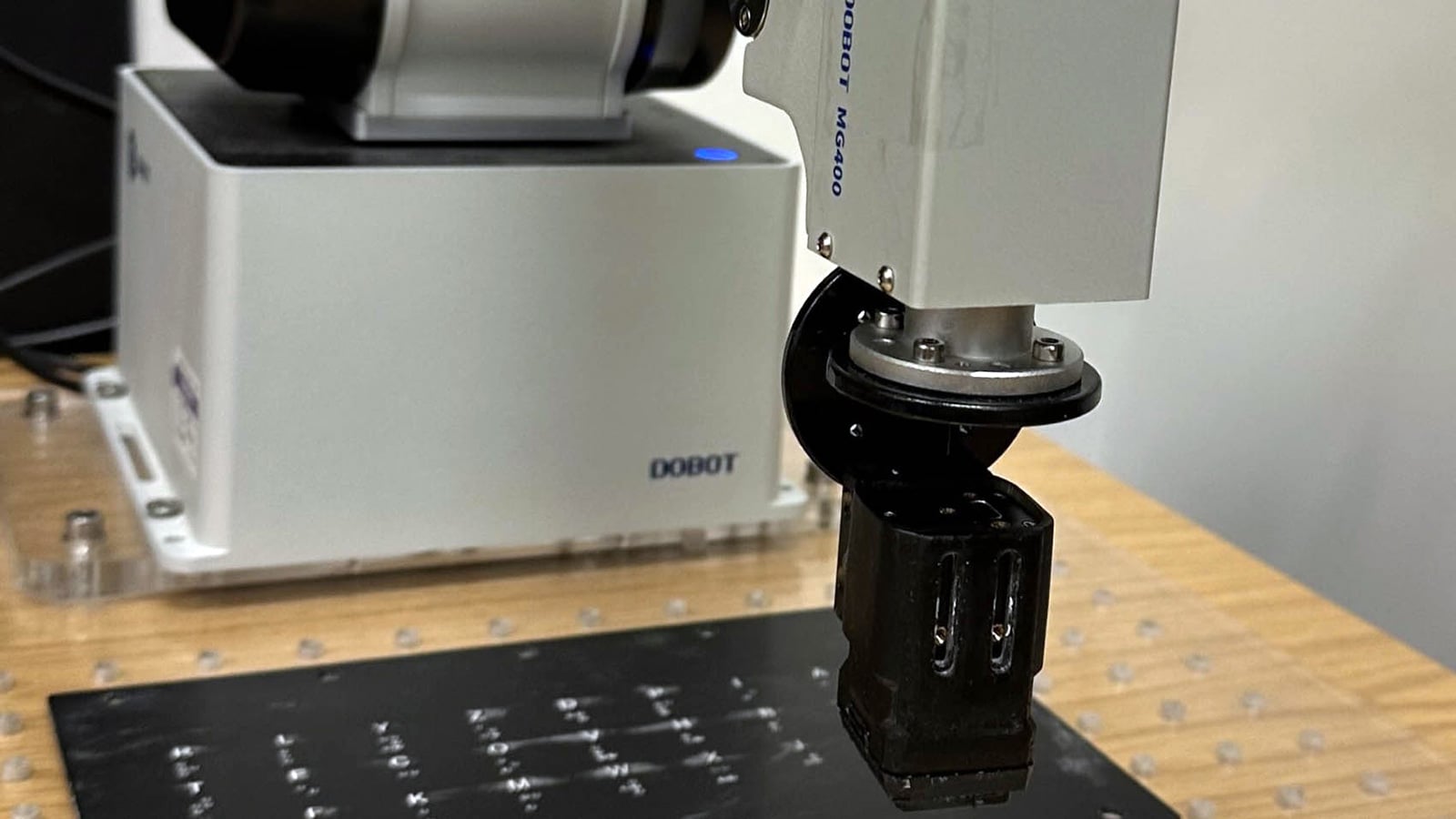
A robot-mounted tactile sensor collects Braille data.
Image credit: Tianyi Liu/University of Bristol
Each letter set off a different pattern of activity in the cells, and a standard computer program matched those patterns back to letters. With one organoid, it picked the right letter 61% of the time, far above the roughly 4% expected from random guessing among 26 letters. With three organoids combined, accuracy rose to 83%. The researchers do not yet know why, though each organoid may contribute slightly different information.
The organoids responded to electrical pulses, and the computer did the letter-spotting. Whether the cells can learn from experience remains an open question. Tianyi Liu, the study's first author and a Bristol PhD student, said the team "did not demonstrate learning or long-term changes in the organoids."
The study says the entire human brain runs on roughly 20 watts, while computer chips designed to mimic it are projected to need thousands to millions of watts at the same scale. Liu said that living neural networks are an interesting possible route to more energy-efficient computing, and that the work gives the team a practical way to connect them to sensors.
Next, Liu said, the team wants to try other kinds of touch, such as textures and edges, and eventually let the organoids receive feedback on their own output to see whether they can adapt.
Read next: Scientists build pencil-tip robots to deliver medicine inside a human heart

