

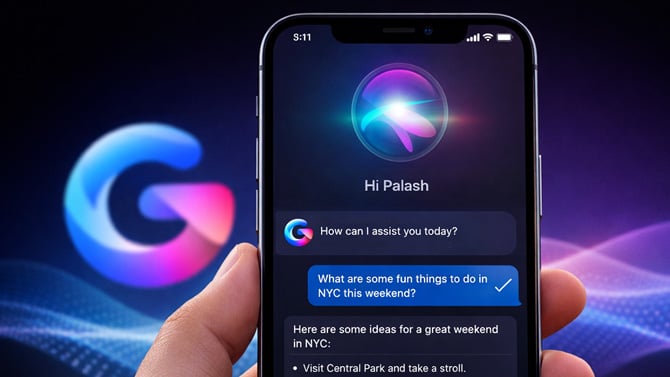
Apple and Google have announced a multi-year partnership to use Google’s Gemini AI models and cloud technology to power Apple Intelligence features, including a rebuilt Siri coming later this year. In other words, Apple is turning to Google for the core intelligence behind its next-generation assistant after a limited and awkward experiment with OpenAI’s ChatGPT.
Apple and Google say the Gemini-based models will still run on Apple devices and Apple’s private cloud, and will follow Apple’s privacy rules. That suggests this is not just a bolt-on service but a deep integration designed to fit into Apple’s ecosystem.
I’ve used Gemini extensively on Android, and while it isn’t flawless, it already does a lot of what people actually want from a phone assistant. It handles natural back-and-forth conversations well, lets you interrupt or change topics mid-stream, and feels closer to talking with a person than issuing commands to a machine. Its tight integration with Gmail, Drive, Keep, and YouTube Music also means it can pull information from across your digital life to answer questions and complete tasks in a way Siri simply can’t today.
Read More: Google's AI Takeover: Assistant Dies, Gemini Rises
That contrast is hard to ignore if you’ve tried to have a real conversation with Siri. Siri tends to hit a wall quickly and fall back to web search results instead of answering you. Gemini, and even the old Google Assistant before it, is far more likely to just give you the answer.
In my own use, Siri has been useful mostly for setting alarms and playing music. Apple’s current ChatGPT integration didn’t fix that. It added friction by asking permission every time before sending a query to ChatGPT, which only highlighted how little Siri could do on its own and how disconnected ChatGPT was from the rest of the system.
There have also been privacy concerns around OpenAI. Bloomberg reported that John Giannandrea, Apple’s former Siri head, told colleagues that ChatGPT was not sufficiently protective of sensitive personal data. That concern likely made it harder for Apple to justify a deep partnership with OpenAI.
Apple originally planned to launch its own fully rebuilt, AI-powered Siri earlier, but delayed it multiple times. In an interview with Tom’s Guide, Apple executives Craig Federighi and Greg Joswiak said the company wasn’t satisfied with the quality of its initial AI efforts. The full transformation wasn’t expected until 2027. Rather than wait that long, Apple now appears to be building on Gemini as the foundation for its AI strategy.
This looks like a long-term decision, not a temporary fix. Apple says its models “will be based on” Gemini, which suggests Google’s technology will underpin Apple Intelligence going forward. That’s very different from the shallow ChatGPT integration, which feels tacked on and poorly connected to Apple services.
Read More: Google's AI Takeover: Assistant Dies, Gemini Rises
I’m not thrilled about Apple putting so much of its AI future in Google’s hands, and I think some skepticism is healthy. Still, Apple has a strong track record on privacy and on turning raw technology into consumer-friendly products. If Apple can combine Google’s AI capabilities with its own privacy standards and platform integration, Siri could finally become something people actually want to use.
For now, Apple says it is not changing its ChatGPT arrangement, so people who like that option inside Siri should still have access to it. Over time, though, Gemini looks poised to become the brain behind Apple’s assistant. If that happens, this partnership may end up being the most important thing Apple has done for Siri in a decade.
[Image credit: Suzanne Kantra/Techlicious via ChatGPT]