

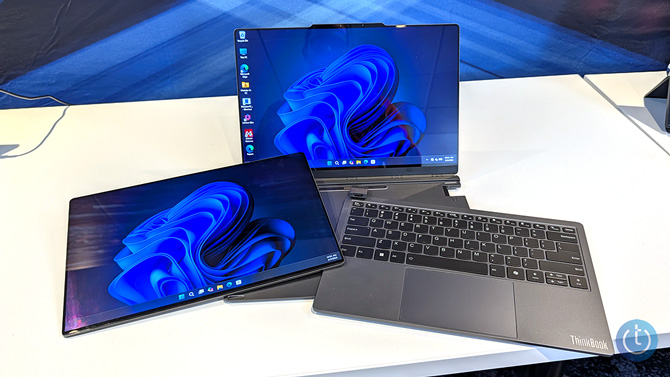
Lenovo is showing off a modular laptop concept at MWC 2026 that lets you detach and rearrange its display, keyboard, and even its ports. The ThinkBook Modular AI PC Concept is built around a 14-inch ultra-thin design, but the idea is that you can reconfigure it depending on what you're doing.
The secondary display is the star here. You can mount it on the top cover for face-to-face sharing in meetings, prop it up alongside the laptop using an integrated kickstand as a portable travel monitor in either vertical or horizontal orientation, or swap it into the keyboard's spot to turn the whole thing into a dual-screen system. Depending on the setup, you can extend the combined viewing to roughly 19 inches. I see this as a more practical way of getting that extra screen real estate than a foldable-display laptop, like Lenovo’s ThinkPad X1 Fold 16 we reviewed in 2024.
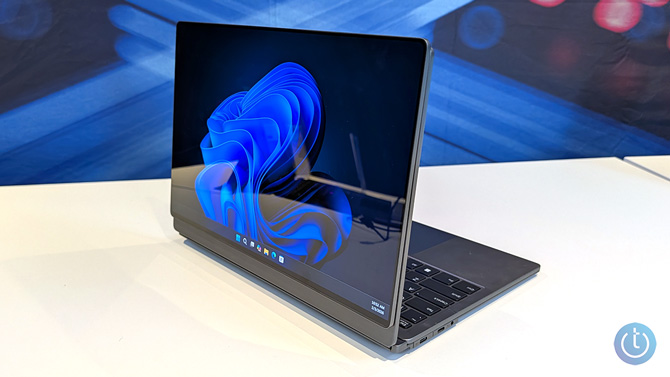
The keyboard itself is a detachable Bluetooth module, which means you can just pop it out and use it on your lap, a desk, or wherever. The I/O ports, including USB Type-A, USB Type-C, and HDMI, are interchangeable too. Lenovo is using pogo-pin connectors to handle power and data between the modules.
Why Lenovo’s stab at a modular laptop matters
Modularity isn’t new. Framework, the most prominent modular laptop company, spent the last few years proving that modular, repairable laptops aren't just a niche idea, and that there’s a solid demand for such machines. Other manufacturers have started following that lead.
Lenovo itself has explored modularity with the repairability-focused "Space Frame" design for the ThinkPad X1 Carbon at CES 2026. The company’s MagicBay pogo pin add-ons were another way it's tested the water with modular laptop displays.
Read more: Lenovo’s Magic Bay Concept: A Clever Take on Modular Displays
Lenovo’s selectively modular approach with the ThinkBook Modular AI PC Concept is more conservative than that of Framework and other modular PC makers, but it’s an interesting idea. Instead of making internals swappable for repair and upgrades, it focuses on making the external form factor modular. This means you don’t get to upgrade the RAM or the SSD, but you can play with components like the keyboard and screen to make the laptop more useful for your needs.
Having spent a lot of my time building PCs, I’m partial towards the concept of fully modular laptops. However, there are also advantages to fully integrated designs. Apple has a tightly integrated design in its Macs, for example, which means you can’t upgrade RAM and storage after purchase. However, the integrated design gives you much better performance. That being said, for a lot of users, the flexibility to modify their laptop’s form factor or extend its life by upgrading its parts is actually useful.
For now, Lenovo’s ThinkBook Modular AI PC is a concept. However, recently we’ve seen some of the company’s concepts, like the ThinkBook Plus Gen 7 Auto Twist and ThinkBook Plus Gen 6 Rollable, show up in the market a year or so later, so we can hope.
[Image credit: Josh Kirschner/Techlicious]