

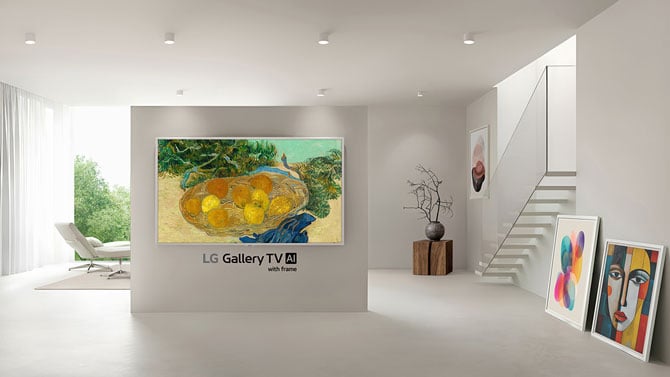
After years of letting Samsung define the “TV as art” category, LG is finally entering the picture-frame TV market with its new LG Gallery TV, debuting at CES 2026. It’s a notable move for a company that already offers one of the largest art ecosystems through its Gallery app – but until now, it didn’t have a dedicated TV designed specifically to look like art on your wall.
The Gallery TV is exactly that: a purpose-built “canvas” for displaying digital art and photos, with a slim, flush wall-mount design, a matte, anti-glare screen, and swappable magnetic frames in 55- and 65-inch sizes. LG says it worked with museum curators to tune brightness and color for displaying artwork, and the screen automatically adjusts based on ambient lighting to maintain a consistent look throughout the day.
This finally puts LG in the same category as Samsung’s The Frame, TCL’s NXTFrame, Hisense’s CanvasTV, and Skyworth’s C1 Canvas TV. But LG isn’t entering as a disruptor. It’s entering as a follower.
A category LG helped build – but didn’t commit to
LG began offering an Art Gallery on its OLED TVs in 2018, and it’s evolved into one of the better art platforms available, with over 4,500 rotating works, generative AI image creation, personal photo display, and support for ambient music. But a software experience isn’t the same thing as a physical product optimized to disappear into your décor.
Samsung proved that in 2017 when it launched The Frame – and then again in 2022 when it added a matte screen that dramatically reduced reflections and made the illusion believable. That shift is what turned “TV as art” from a gimmick into a category.
The real limitation – display technology
LG’s Gallery TV uses a Mini LED panel with its Alpha 7 AI processor. That’s respectable and meaningfully better than the edge-lit QLED panels used in early Frame-style TVs. But it still falls short of the best panels now appearing in this category.
Samsung’s The Frame Pro, which we awarded a Techlicious Top Pick of CES 2025, features a Neo QLED Mini LED panel that combines quantum dot color filters with a Mini LED backlight for better contrast, color volume, and brightness. That’s what makes the Frame Pro look genuinely good both as art and as a TV, instead of forcing you to choose between aesthetics and performance.
This fall, Skyworth went even further with its Canvas Elite. It uses a full-array QD-Mini LED panel with over 1,000 local dimming zones, 2,000 nits of brightness, and a 144Hz refresh rate, paired with its own advanced matte screen technology. It is up to twice as bright as The Frame Pro and should offer better contrast and the ability to render detail in very dark and very light scenes. When I saw Canvas Elite, it looked like a higher-end TV – not just “good enough for art.”
Design parity, not leadership
From a design standpoint, LG is checking the expected boxes: flush wall mounting, magnetic bezels, internal storage for art, glare reduction, and an art-centric mode that prioritizes texture and tone over raw brightness. That puts it on par with competitors, not ahead of them.
And unlike Samsung’s wireless One Connect Box, which solves the cable problem for wall-mounted TVs and makes the “art illusion” more convincing, LG is sticking with an all-in-one design. That’s simpler, but not necessarily better if you have multiple external devices, such as a gaming console or streaming media player, that you need to plug into the TV. You’ll need to hide those power cords and video cables, too.
If you want the best combination of art-display realism and TV performance today, Samsung’s The Frame Pro and Skyworth’s Canvas Elite still set the bar. LG’s Gallery TV will appeal to people already invested in LG’s ecosystem of audio gear, smart appliances, and air care, or who prefer its design and WebOS interface – but it doesn’t yet change the conversation. It simply joins it.
[Image credit: LG]