

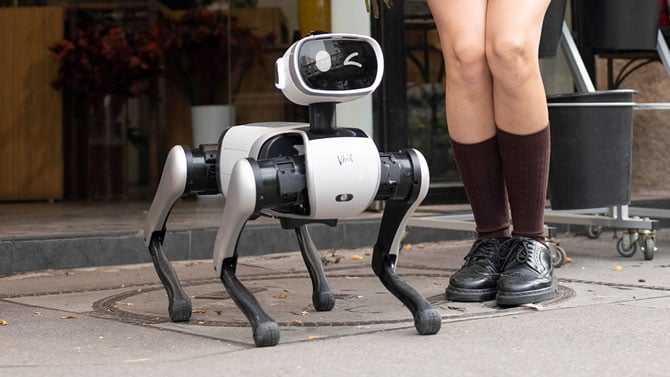
Vbot's Companion Robotic Dog, set to debut at CES 2026, is positioned as a family-friendly robot that the company says can follow you around, take photos and videos, and help with tasks around the house. We’ve seen robot dogs before, like Boston Dynamics’ very popular Spot, made for industrial use, and Sony’s relaunched Aibo robot dog meant to be a companion. Vbot is aiming for a middle ground between commercial tools and expensive toys.
The Companion Robotic Dog is designed to work in three main roles. It can follow you around as a companion, film video hands-free as a personal videographer, and act as what Vbot calls a Home Guardian Helper to help you complete tasks and navigate. The company says it responds to voice commands and uses a head that tilts and rotates for expressive gestures. Vbot has not announced pricing, availability, or its final feature set yet, making it hard to assess its value proposition beyond being a statement piece.
A focus on safety and quietness
The robot uses 22cm (8.7 inch) leg segments that Vbot says allow it to climb standard stairs anywhere in the world – unlike wheeled robots, including robot vacuums, which can get stuck. The Companion is powered by Vbot's N45 motor, which the company says delivers high torque (turning force) at 25% less weight than competing motors. This should make the robot dog faster and more stable, but it may not be as fast as your pup.
The 594Wh battery is meant for over five hours of outdoor use. Vbot has also kept safety in mind with the design. The robot's 2.5cm (1 inch) gap between moving parts is wide enough to prevent pinching an errant finger. The bot is rounded at all corners, and its body is covered in a soft mesh. Vbot also uses 3D-printed shock-damping feet and precision motors, which it says make the Companion quiet enough to use around sleeping children. Given that the robot dog aims to be a relatively affordable option, we appreciate that Vbot has still managed to build it quietly. Although we’ll have to take it for a spin to check exactly how quiet it actually is.
Seeing and understanding spaces
The robot is loaded with sensing tech. It uses LiDAR (laser distance sensing) as seen in cars with advanced driver assistance systems, to detect obstacles. It also supports UWB (ultra-wideband) tracking, like AirTags, so it can be easily found. There’s a four-mic setup with dual-depth cameras to help it perceive its surroundings from all angles. All of this is processed locally with a very powerful 128 TOPS (trillions of operations per second) chip. That means it doesn’t need to hook up to the cloud to work properly in your home.
Read more: Researchers Show Robots Can Be Jailbroken to Harm Humans
Vbot says the robot can distinguish between different types of objects and between navigable paths and obstacles. This lets it move through spaces like crowded rooms or outdoor trails. Of course, those are tall claims, so we’ll need to see how it holds up in the real world.
Following commands and adapting
The Companion Robotic Dog is designed to follow canine commands like "bring," "follow," "lead," "show," or "find." Vbot says it can translate these statements into a series of actionable steps to achieve the goal. The company claims the robot is smart enough to guide you through outdoor spaces such as campsites, hotel grounds, parks, and trails using its sensors and onboard spatial model.

It's also designed to adapt in real time. This robot dog can adjust its walking speed to match yours, greet visitors, and reposition itself for better camera angles. The Follow Me and Camera Buddy features seem like the most practical ones for outdoor activities and family events, if they work as expected.
[Image credit: Vbot]


From John horspool on March 02, 2026 :: 3:23 pm
Can you please let me know when you are selling the v bot
Reply