

Mobile World Congress (MWC) is where the mobile industry shows its hand for the year ahead. Some products are close to shipping, others are bold concepts meant to test new ideas, and a few hint at where personal technology may be headed next.
As we walked the show floor in Barcelona this week, it was clear that manufacturers are pushing well beyond incremental upgrades. We saw phones with robotic camera systems, modular laptops that can be reconfigured on the fly, ultra-thin batteries, and displays designed to be easier on your eyes during long hours of use.
Each year, the Techlicious team looks for the products that stand out – not just because they’re flashy, but because they introduce a smart idea, solve a real problem, or move technology forward in a meaningful way. Some are practical innovations you’ll likely see on store shelves soon. Others are early concepts that could influence the devices we carry in the years ahead.
Below are our MWC 2026 Editor’s Choice Award Winners.
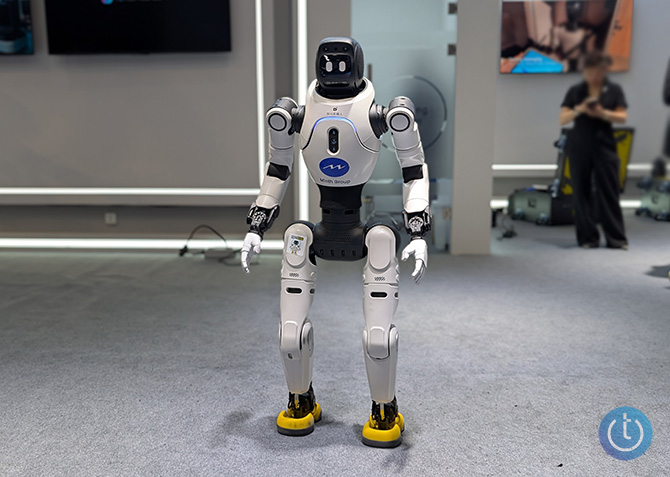
AGIBOT X2
The Agibot X2 is a half-size humanoid robot designed for entertainment, hospitality, and commercial interaction. Standing about 52 inches tall and weighing 77 lbs, the robot features 25 degrees of freedom and a wide range of full-body motion capabilities that allow it to perform agile movements such as dancing, gesturing, and self-righting. It incorporates an interactive RGB camera system, facial and gesture recognition, and multimodal interaction features that enable voice, touch, and visual responses. The X2 can walk at speeds up to 2 m/s and supports customizable motion skills, motion choreography, and programmable behaviors through its onboard computing modules.
What makes the X2 particularly exciting is how advanced its physical capabilities already are. Its balance, agility, and expressive movements demonstrate how far humanoid robotics has come in a short time. As AI systems continue to improve at a rapid pace, robots like the X2 could quickly evolve from novelty performers or brand ambassadors into intelligent assistants capable of meaningful independent work and interaction. The X2 offers a glimpse of that future.
Price and availability: Not for consumer sale
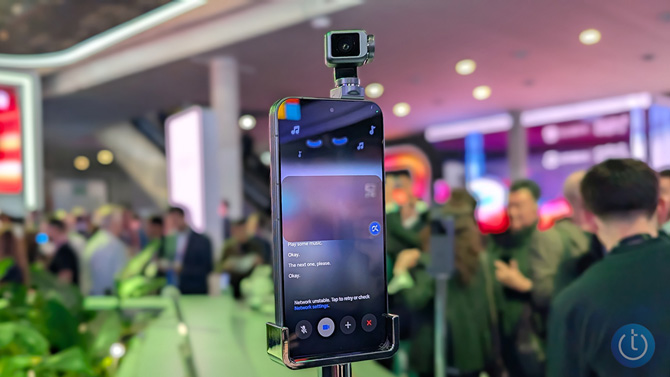
Honor Robot Phone
Honor’s Robot Phone rethinks what a smartphone camera can do by adding physical movement to the device itself. Instead of relying solely on software stabilization, the concept phone integrates an ultra-compact motorized gimbal system with four degrees of freedom and a 200MP camera sensor. The system allows the camera module to tilt, rotate, and track subjects in real time, supported by AI-powered features like object tracking and multi-axis stabilization for smoother video capture. The phone can even perform cinematic moves such as 90° and 180° rotations and automatically follow users during video calls, creating a far more dynamic capture experience than traditional fixed cameras.
At first glance, a moving camera module might seem gimmicky. But in practice it solves a real problem: smartphones force you to stay in frame, while this phone follows you instead. For content creators, athletes capturing training sessions, or anyone taking video calls while moving around, that could be genuinely useful. The Robot Phone hints at a future where smartphones become more active participants in capturing and interacting with the world around us, rather than passive devices we have to position and hold just right.
Price and availability: Expected to launch in China in the second half of 2026; global availability and pricing have not been announced
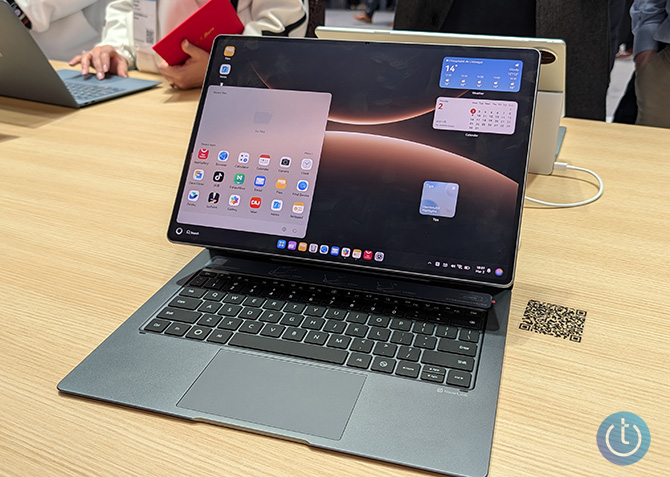
Huawei MatePad Edge
The Huawei MatePad Edge is designed to blur the line between tablet and laptop, pairing flagship hardware with a large 14.2-inch flexible OLED “Cloud Clear Soft Light” display that focuses on both visual quality and eye comfort. The matte-style screen uses diffuse reflection technology to reduce glare from lamps and sunlight while maintaining strong brightness, contrast, and color accuracy. With a 3.1K resolution, P3 color gamut, and up to 1,000 nits of brightness, the display delivers a high-end viewing experience while remaining noticeably easier on the eyes than typical glossy tablet panels.
As impressive as the specs are on paper, the MatePad Edge was even more striking in person when we saw it at MWC. The matte display looks beautiful while making extended reading and work sessions much more comfortable. Huawei also put a lot of attention into the accessories. The floating keyboard and adjustable stand feel genuinely premium, both in materials and in the smoothness of their movement, making the tablet feel far closer to a full laptop experience than most tablet keyboard setups.
Price and availability: Available now in China starting at ¥5,999
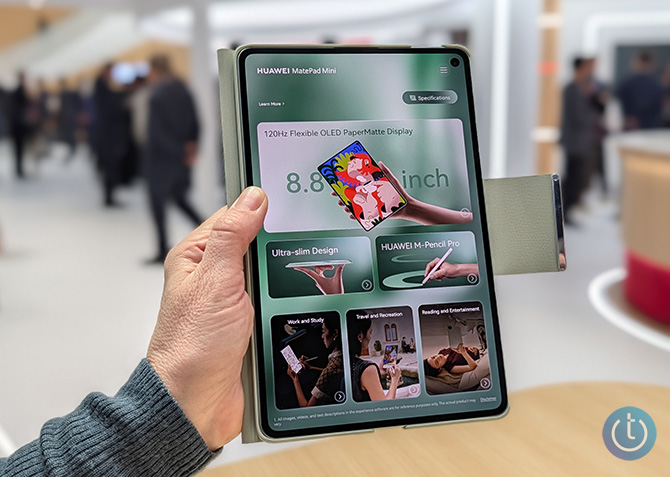
Huawei MatePad Mini
Huawei’s MatePad Mini PaperMatte brings something genuinely different to the tablet category – a high-end display designed to be as comfortable on the eyes as an e-reader while still delivering flagship tablet performance. Its 8.8-inch flexible OLED PaperMatte display uses an optical diffusion layer and anti-glare technology to soften reflections and reduce screen sparkle, making it much easier to read or work for long stretches. Despite the focus on eye comfort, the display still delivers premium specs including a 2.5K resolution, 120Hz refresh rate, up to 1,800 nits of brightness, and excellent color accuracy.
What impressed us most when we saw the tablet at MWC was how natural the screen felt – closer to reading on paper than staring at a typical glossy tablet display. And Huawei didn’t treat it like a stripped-down e-reader replacement. The MatePad Mini pairs that comfortable display with strong hardware, including a slim 5.1mm chassis, a large 6,400mAh battery with 66W fast charging, and a stylish vegan fiber back panel that gives the tablet a premium look and feel. The result is a compact tablet that combines the readability of an e-ink device with the power and versatility of a modern OLED tablet.
Price and availability: Not announced.
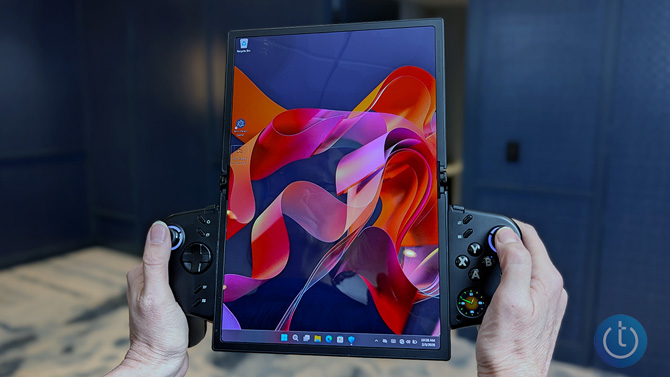
Lenovo Legion Go Fold Concept
Lenovo’s Legion Go Fold Concept reimagines what a portable gaming system can be by combining a handheld gaming console, a foldable tablet, and a laptop into one device. At its core is a foldable POLED display that expands from a 7.7-inch handheld screen to an 11.6-inch display, paired with detachable controllers similar to those on the existing Legion Go. Powered by an Intel Core Ultra 7 processor with 32GB of RAM and a 48Wh battery, the concept packs full PC-class hardware into a compact form factor designed for gaming on the go.
What makes the Legion Go Fold particularly compelling is its versatility. In addition to traditional handheld gaming, the foldable screen enables multiple modes, including a split-screen setup for gaming while watching a walkthrough and an expanded desktop mode that pairs the display with a wireless keyboard to function like a laptop. In our testing and conversations at MWC, this dual-purpose approach stood out as the device’s real strength – it eliminates the need to pack both a laptop and a gaming handheld when traveling. With foldable displays becoming more durable and portable gaming PCs growing more powerful, the Legion Go Fold Concept hints at a future where one device can realistically handle both work and play.
Price and availability: Concept device; pricing and availability have not been announced.
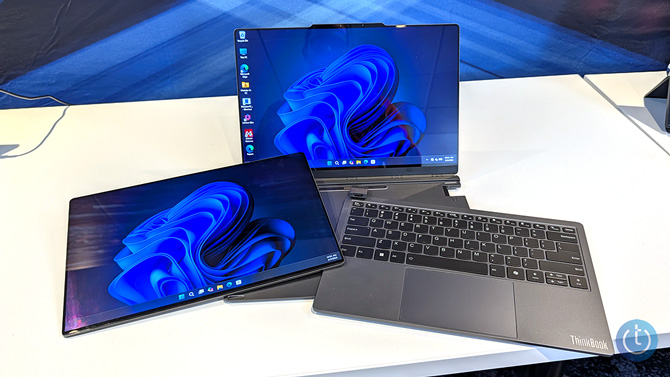
Lenovo ThinkBook Modular PC Concept
Lenovo’s ThinkBook Modular AI PC Concept explores a different take on laptop flexibility by making the external components modular rather than the internal hardware. Built around a slim 14-inch laptop, the concept allows users to detach and rearrange parts like the display, keyboard, and even the I/O ports. A removable secondary screen can mount on the back of the lid for sharing presentations, sit beside the laptop as a portable travel monitor, or replace the keyboard to create a dual-screen setup that expands the workspace to roughly 19 inches. The keyboard itself is a detachable Bluetooth module, while interchangeable ports – including USB-A, USB-C, and HDMI – connect through pogo-pin interfaces that handle both power and data.
What makes the concept interesting isn’t just the modularity, but how Lenovo is applying it. Rather than focusing on repairable internals like some modular laptop designs, Lenovo is experimenting with modular form factors that adapt to how people actually use their computers. The detachable displays, keyboard, and add-on components make it easy to reconfigure the laptop for meetings, travel, or productivity without carrying extra gear. And while it’s still a concept, Lenovo has a track record of turning some of its more ambitious ideas into real products, so this modular approach could eventually make its way into future ThinkBook systems.
Price and availability: Concept device; pricing and availability have not been announced.
OUKITEL WP63 Rugged Smartphone
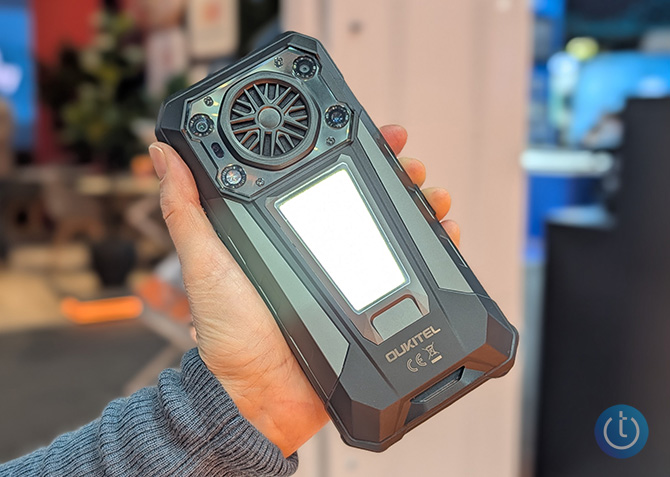
The Oukitel WP63 is a rugged smartphone built for serious outdoor use, combining the durability and endurance expected from a field-ready device with a few features you won’t find on a typical phone. At its core is a massive 20,000mAh battery that can run for days and even serve as a power bank for other devices through 18W reverse charging. The phone also includes a bright camping light, a powerful loudspeaker, and a 6.7-inch 120Hz display powered by a Unisoc T8200 chipset. But the feature that immediately grabbed our attention at MWC was something far more unusual – a built-in electronic igniter designed to start campfires, light gas stoves, or ignite other outdoor equipment.
When Oukitel demonstrated the igniter function to us at the show, it was clear this wasn’t just a gimmick. For hikers, campers, or anyone spending time off the grid, having a reliable fire starter built directly into your phone could be genuinely useful in real-world situations. Combined with the phone’s enormous battery, integrated lighting, and rugged design, the WP63 feels purpose-built for outdoor adventures. It’s less about adding flashy features and more about turning a smartphone into a practical survival tool you’ll always have at your side.
Price and availability: Available in April for $499

RayNeo Air 4 Pro
The RayNeo Air 4 Pro AR glasses stand out as the first in the category to feature an HDR display, a meaningful upgrade for a device designed primarily for watching movies and playing games. Powered by RayNeo’s Vision 4000 processor and micro-OLED displays, the glasses support HDR10 playback to deliver deeper contrast, brighter highlights, and more vibrant colors than typical AR viewing systems. The glasses create the experience of watching a massive 135-inch screen while remaining extremely lightweight at just 76 grams. RayNeo also collaborated with Bang & Olufsen to tune the audio system, helping deliver a more cinematic experience for portable entertainment.
Adding HDR to AR glasses makes perfect sense for a product built around immersive media consumption. In our view, it’s one of those obvious improvements that feels overdue once you see it in action. RayNeo also leaned into the entertainment angle with a set of interchangeable themed accessories, including Batman and Joker cover designs that give the glasses a bit of personality. Together with the improved display technology, they reinforce the idea that the Air 4 Pro is less about productivity and more about delivering a personal theater you can carry anywhere.
Price and availability: Available now for $299 through Amazon and RayNeo
REDMAGIC 11 Pro
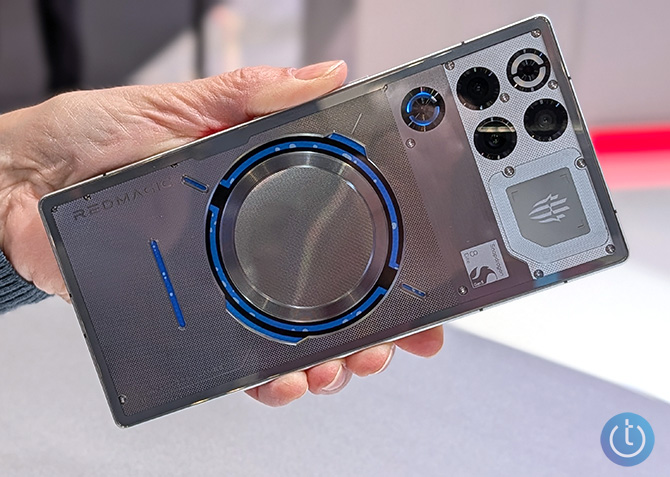
The REDMAGIC 11 Pro pushes gaming phone design in a bold new direction with what the company calls the first mass-produced flowing liquid cooling system inside a smartphone. The AquaCore cooling setup uses server-grade fluorinated liquid circulating through sealed channels to absorb and move heat away from the processor, working alongside liquid metal thermal material, a large vapor chamber, and a 24,000-RPM internal cooling fan. The goal is simple – keep the Snapdragon 8 Elite Gen 5 processor running at peak performance during long, graphics-intensive gaming sessions without thermal throttling.
But beyond the practical benefit of better heat management, the system is also visually striking. Through the transparent back panel, you can actually see the cooling liquid moving through the phone, something we found genuinely mesmerizing when we saw it in person at MWC. It’s a serious engineering solution that happens to look incredibly cool while it’s doing its job.
Price and availability: Starting at $749 on REDMAGIC
Soundcore Space 2
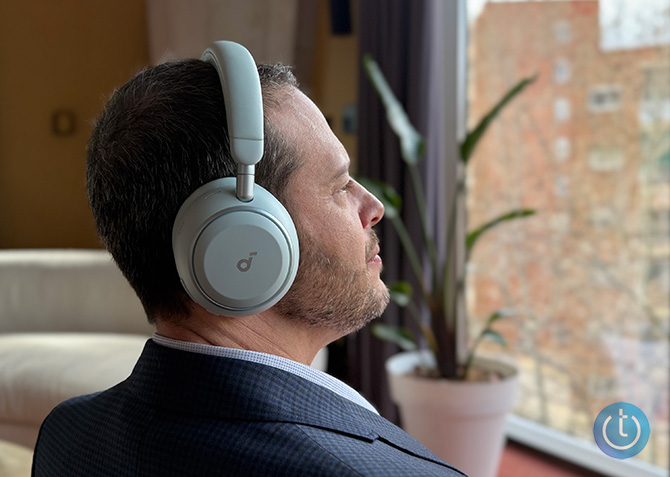
The Soundcore Space 2 headphones bring meaningful upgrades to Anker’s travel-focused ANC lineup, with a redesigned noise cancelling system aimed specifically at blocking low-frequency sounds like jet engines and transit rumble. The new four-stage adaptive noise cancelling system automatically adjusts to different environments, helping reduce background noise whether you’re on a plane, bus, or in a busy office. The headphones pair that ANC performance with 40mm double-layer diaphragm drivers for high-resolution audio and long battery life – up to 50 hours with ANC enabled and as much as 70 hours with noise cancelling turned off.
Just as important, the Space 2 feels great to wear. When we tried them on at MWC, they stood out for how light and comfortable they were, with soft memory foam padding that made them easy to imagine wearing for long flights. Soundcore is also adding a clever one-button “nap mode,” which activates noise cancelling to help you grab a few minutes of shut-eye while traveling. And aesthetically, these are among the better-looking headphones in the category – particularly in the seafoam green color, which gives them a fresh look compared with the usual black and silver designs.
Price and availability: $129.99; expected to launch April 21 in the U.S. on Amazon and Soundcore.com.
TCL NXTPAPER 70 Pro
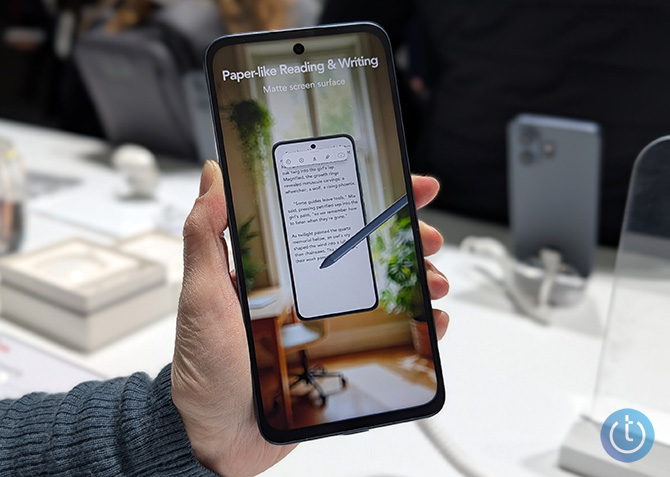
The TCL NXTPAPER 70 Pro takes a different approach to smartphone displays, focusing on comfort for reading and long viewing sessions. TCL’s NXTPAPER 4.0 screen combines an anti-glare surface, reduced blue light, and flicker-free technology to create a display that feels closer to paper than a traditional glossy smartphone screen. A dedicated NXTPAPER Key lets you instantly switch between standard color viewing and paper-style modes designed for reading and focus.
Beyond the display, the phone is built to function as a full-featured daily driver. It runs on a MediaTek Dimensity 7300 processor with up to 512GB of storage, a 50MP main camera with OIS, and a large 6.9-inch FHD+ 120Hz display when used in standard color mode.
The e-ink-like reading mode is really impressive in person. It’s easy on the eyes, especially when you’re scrolling through long articles or books, and it has a practical side benefit – dramatically improved endurance. TCL says the phone can last up to seven days of reading in Max Ink Mode and up to 26 days in standby, thanks to the low-power display mode. That combination of a comfortable matte display and extended battery life makes the NXTPAPER 70 Pro particularly appealing for people who use their phone as a primary reading device.
Price and availability: €299 for the 256GB version and €359 for the 512GB model, with global availability beginning in early 2026.
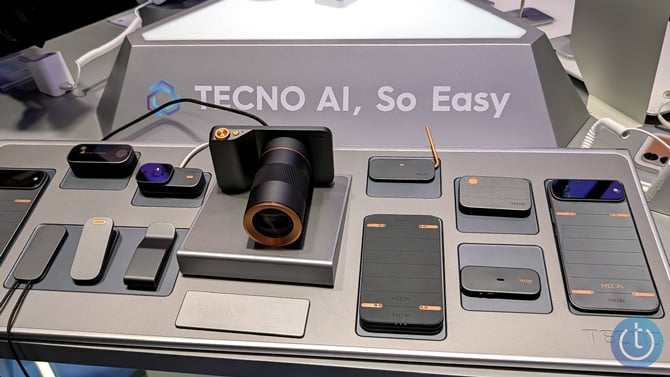
TECNO Modular Phone
TECNO’s Modular Magnetic concept was one of the most fascinating devices we saw at MWC. The idea is simple but powerful: instead of building every feature into the phone itself, you snap on what you need. Ultra-thin magnetic modules attach to the back of the phone, including a 4.5mm battery pack, an action camera, and even a standalone telephoto lens. When we saw it in person, it felt like a true Swiss-army-knife phone – a device that can transform depending on the situation.
What caught our attention was how natural the system feels. Magnetic attachments have already become familiar thanks to systems like MagSafe, so snapping hardware modules onto a phone feels like a logical next step. TECNO currently has about ten modules in development, and despite the added functionality the design remains close to the thickness of a normal smartphone. It’s still a concept, but if TECNO can turn this into a real ecosystem of accessories, it could finally make the long-promised idea of modular smartphones practical.
Price and availability: Concept device; pricing and availability have not been announced.
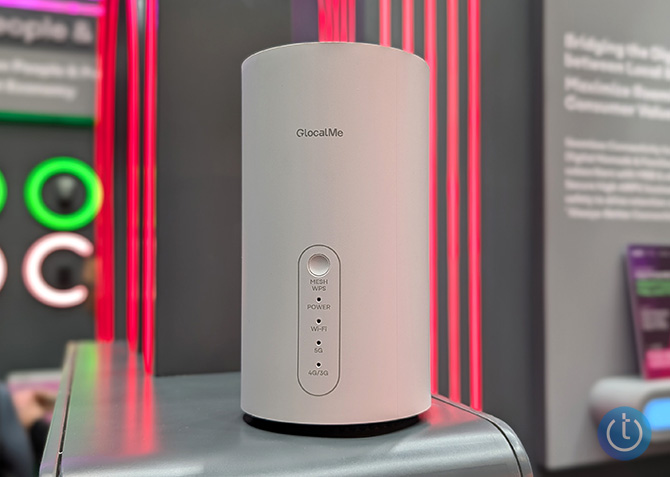
uCloudlink OmniFlex Pro
The OmniFlex Pro is designed to deliver reliable, high-speed internet wherever you need it, combining 5G connectivity with Wi-Fi 6 in a compact plug-and-play router. Using CloudSIM technology and AI-powered network management, the device can automatically switch between fixed broadband and mobile networks to maintain a stable connection, even if one network slows down or fails. With support for up to 128 connected devices and speeds that can reach up to 4Gbps on 5G, it’s built to keep everything online – from laptops and smart TVs to security systems and smart home devices.
That makes the OmniFlex Pro especially compelling for people who need dependable connectivity outside a traditional home setup. It’s perfect for internet on RVs and boats, delivering the same kind of whole-home connectivity you’d expect from a residential router. And for homes or small offices where uninterrupted internet service is essential – not just convenient – the automatic failover between broadband and cellular networks provides a built-in safety net that keeps you connected even when your primary service goes down.
Price and availability: Pricing and availability have not been announced
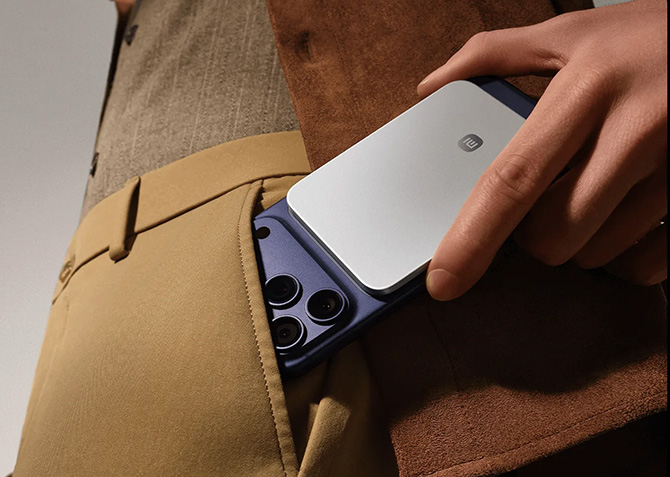
Xiaomi UltraThin Magnetic Power Bank 5000 15W
Power banks are incredibly useful, but let’s be honest – nobody enjoys carrying around the extra bulk. Xiaomi tackles that problem head-on with the UltraThin Magnetic Power Bank 5000 15W, designed to be the world’s thinnest power bank. At just 6mm thick and weighing only 98 grams, it’s closer to the size of a credit card than a traditional battery pack, making it easy to slip into a pocket or small bag without adding noticeable weight or bulk.
Despite its ultra-slim design, Xiaomi didn’t sacrifice performance. The silicon-carbon power bank includes a 5000mAh battery, supports 15W magnetic wireless charging, and also offers fast wired charging through USB-C. Magnetic alignment keeps the battery securely attached while charging, making it easy to power up your phone while on the move. The result is a power bank that delivers the convenience of portable charging without the usual size trade-off.
Price and availability: Available now. Pricing varies by market.
[Image credit: Techlicious, Xiaomi]