

The day after Christmas, New York Governor Kathy Hochul signed legislation, known simply as S4505/A5346, which requires social media platforms with "addictive feeds, auto play or infinite scroll" to feature warning labels or face penalties of up to $5,000 per violation. The implementation date will depend on when the state attorney general finalises rulemaking. The warning will appear to all users, although the text focuses on protecting minors. This is far from a ban, and follows similar state laws. Colorado's went into effect in August 2024; ones in Minnesota and California start in July 2026 and January 2027.
Other states have gone farther. In 2025, Tennessee and Mississippi began requiring age verification and parental consent for those under 18, and Floriday banned social media for kids under 14 and required consent for ages 14 and 15. On January 1, Virginia will limit kids to one hour of social media per day, unless parents consent to more; and in July, Nebraska will require the parents OK for kids under 18.
But recent events in Australia reveal how hard age verification, consent requirements, and bans are to enforce on clever teens.
Taking effect earlier this month, the country's social media restrictions for young teenagers are barely in place, yet under-sixteens are already finding clever workarounds. From VPNs to borrowed devices, tech-savvy teens are pushing back, raising fresh questions about how effective the ban can really be in a digital world full of loopholes.
Australia’s New Social Media Ban: First of Its Kind
The Online Safety Amendment (Social Media Minimum Age) Act 2024, announced on December 10, is the first national social media ban for minors. It requires major tech platforms such as Google, YouTube, TikTok, Facebook, Instagram, and X to remove users under 16 or face fines of up to A$49.5 million (US$33 million).
At risk are roughly 440,000 Snapchat accounts, 150,000 Facebook accounts, and 350,000 Instagram accounts held by children aged 13 to 15. TikTok has already deactivated more than 200,000 accounts.
How Tech Platforms Are Enforcing Age Restrictions
While Prime Minister Anthony Albanese called it “a proud day,” Elon Musk’s X said, “It’s not our choice – it’s what the Australian law requires” – a stance shared by other platforms now scrambling to comply.
Compliance measures include AI-powered age-assurance tools and ID-based verification to identify users under 16. Snapchat, for instance, is using Singapore-based k-ID, which verifies users via government-issued ID, a bank confirmation SMS, or a selfie. But despite these systems, teens are slipping through the cracks.
Read more: One in Three Teens Are Almost Always Online
The Most Common Workarounds Teens Are Using
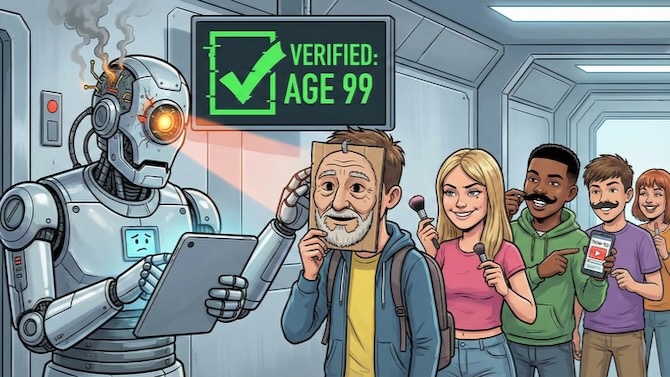
According to the Australian Broadcasting Corporation (ABC), Cassandra, a New South Wales mother, said her 14-year-old son changed his age to 23 and still passed k-ID’s selfie verification.
Another parent, Matt, said his 13-year-old son passed the face-verification scan by “hiding his teeth and scrunching up his face,” leading the system to classify him as over 30.
Jillian reported that her 12-year-old daughter and her friends put on fake lashes and makeup, and were verified as 17+. Meanwhile, some teens who are old enough, like Melissa’s 16-year-old daughter, are being blocked because their scans incorrectly categorize them as younger.
Experts say this is possible because age-assurance systems can have an error margin of one to three years, or even more in some cases.
Other Ways Teens Are Getting Around the Restrictions
Selfie manipulation isn’t the only workaround. According to Lisa Given, a professor of information sciences at RMIT University, teens can still access social platforms using VPNs that make them appear to be outside Australia.
Read more:The Best VPNs for Protecting Your Privacy
They can also present fake IDs, alter their appearance, or have older siblings and friends complete facial scans on their behalf. Borrowing devices from adults is another easy workaround.
Some teens are already sharing online tutorials on how to beat the system, along with posts bragging about “surviving” the ban and mocking the Prime Minister on TikTok. The government acknowledges that current age-verification tools are not foolproof but says new technologies and enforcement measures are on the way to tighten compliance.
[Image credit: Sean Captain/Techlicious via Nano Banana]


From The Age Verification Providers Association on December 30, 2025 :: 7:55 am
Age assurance is designed to prevent most underage users, most of the time, not all those underage, all of the time. Why? Because to achieve 100% accuracy would be highly inconvenient to those over the legal age. As an industry, we consider 95% to be “highly effective” - a benchmark agreed with regulators such as the UK’s Ofcom. So mathematically, there will definitely be kids below the age who get through, and those overage who need to use a secondary method to prove their age if their first attempt was with an estimation option that failed.
We can increase the accuracy level - and do, for example, when selling knives onlines in the UK as that is a a proportionate response to a higher risk level. But regulators have not indicated this is justified for social media use-cases.
Reply